CONSTRUCTION LEADS
Construction Leads: Where They Come From, What They Cost and How to Win Them
Construction leads come from six places: bid platforms, plan rooms, permit data, public contract notices, referrals and your own outreach and search presence. Several are free, such as SAM.gov and city permit data. Paid project-data services run from $1,999 a year on PlanHub to $10,000 a year and up on ConstructConnect Premium.
A lead is only worth what it costs to win. Construction work leads that every subscriber in your market also sees turn into bidding contests, and the estimating hours often cost more than the subscription. This guide lists the sources with published prices, separates project leads from client leads, shows the cost per won job math and covers who to contact for commercial construction leads.
We reply within 2 business hours. Plans are month-to-month; cancel with 30 days’ notice.
CONSTRUCTION LEADS
Where do construction leads come from?
Construction leads come from sources that list projects already moving toward a bid, sources that show work earlier, and relationships you build yourself. Prices below were checked , on each vendor's own page unless the table says otherwise.
| Source | What it gives you | Published cost | Lead type |
|---|---|---|---|
| SAM.gov | Federal contract notices: pre-solicitations, solicitations, awards and sole source notices | Free; anyone can search without an account | Project lead |
| SBA SubNet | Subcontracting opportunities posted by large prime contractors | Free for small businesses to search | Project lead |
| City permit open data (example: City of Austin) | Issued permits with date, location, description of work, square footage and valuation | Free | Early signal |
| Shovels | Building permit records and contractor data | Free plan $0 (1 year of history); Basic $599 a month; Pro $999 a month | Early signal |
| Construction Monitor | Building and solar permit leads, updated daily | No price on the home page | Early signal |
| BuildingConnected | Bid invitations from general contractors who use it | Bid Board is free for subcontractors | Project lead |
| PlanHub | Projects posted by general contractors, plus a GC directory of over 55,000 firms | Free profile for local invitations; Premier $1,999 a year (50 miles), $2,349 (100 miles), $3,299 (200 miles) | Project lead |
| The Blue Book | Directory and bid-stage projects; part of Dodge Construction Network | No price on the home page | Project lead |
| ConstructConnect | Commercial projects open for bid, documents and contacts | Professional from $199 a month per market, per seat, billed annually; Premium from $10,000 a year | Project lead |
| Dodge Construction Network | Projects tracked from pre-planning and design through permit and construction start | Not listed on the page checked | Project lead, early |
| BuildZoom | Matches owners with contractors | 2.5% of the job, paid only if you are hired, per WebFX | Client lead |
| Referrals and repeat clients | Work from owners, architects and GCs who know you | Your time | Client lead |
| Your website, search profile and outreach | Owners and property managers who contact you, or who you contact first | Your time or an agency retainer | Client lead |
Two things stand out. The free sources are free because they are public records or networks that want subcontractors on them. The paid sources charge for convenience, coverage and contact details, not for exclusivity: every subscriber in the same market sees the same project.
DIFFERENCE BETWEEN
What is the difference between construction project leads and client leads?
A project lead is a specific job heading to bid. A client lead is a person or company that will hire contractors again and again. Most construction lead generation sells the first kind. Most profit comes from the second.
| Construction project leads | Client leads | |
|---|---|---|
| What it is | A project with plans, a bid date and a list of invited bidders | An owner, developer, property manager or GC who buys construction repeatedly |
| Where it comes from | Bid platforms, plan rooms, public notices, permit data | Referrals, outreach, your website and search profile, past jobs |
| Who else sees it | Every subscriber in that market, and every invited bidder | Usually only you, until the buyer opens a bid |
| How you win | Lowest qualified price, or best value on a short list | Trust, fit and a track record with that buyer |
| What it leads to | One job | A vendor relationship and repeat work |
Project leads keep estimators busy. Client leads decide who gets invited to bid in the first place. A contractor that depends only on bid boards is always competing on price for work someone else has already scoped.
FIND FREE
Where can you find free construction leads?
Free construction leads come mostly from public records and from networks that general contractors use to invite bids. Each costs time to sort, not money.
- SAM.gov for federal work. SAM.gov lists federal contract opportunities, including pre-solicitation and solicitation notices. Anyone can search without an account; an account lets you save searches and join interested vendor lists. To bid as a prime contractor, the SBA says you first register your business in SAM.
- SBA SubNet for federal subcontracts. The SBA says any large business can post a subcontracting opportunity to SubNet, and small businesses can search and view the posts. Federal contracts awarded to large businesses above a dollar threshold must include a small business subcontracting plan.
- City permit data. Many cities publish issued permits. The City of Austin's Issued Construction Permits dataset includes issue date, location, description of work, square footage, valuation and units. A new commercial permit with a large valuation names a project and often a contractor you can contact.
- Shovels' free plan. Shovels lists a free plan at $0 a month with one year of record history and 500 credits a month.
- BuildingConnected Bid Board. BuildingConnected's glossary calls Bid Board its free tool for subcontractors to accept and submit bids, submit qualifications and access project files. You need to be on a GC's list to be invited.
- PlanHub's free profile. PlanHub says you can create a free profile to receive direct invitations from general contractors and bid on projects within a local radius.
- Your past clients and GCs. Owners who hired you once and GCs you bid with last year are the most likely source of the next invitation. A short call or email after each closeout costs nothing.
Free sources fill a bid calendar. They do not make a buyer prefer you, which is why the next sections matter.
PAID CONSTRUCTION
What do paid construction lead services cost per won job?
The subscription is usually the smaller cost. Estimating time on bids you lose is the larger one. Cost per won job counts both.
Cost per won job = (subscription + estimating cost of every bid) ÷ jobs won
The inputs below are example inputs with round numbers. Swap in your own bids, win rate and estimating cost.
| Input | PlanHub Premier, 50 miles | ConstructConnect Professional, 1 market |
|---|---|---|
| Subscription a year (published price) | $1,999 | $199 × 12 = $2,388 |
| Bids a year (example input) | 96 (8 a month) | 96 (8 a month) |
| Estimating cost per bid (example input: 6 hours at $60) | $360 | $360 |
| Win rate (example input) | 15% | 15% |
| Jobs won | 14.4 | 14.4 |
| Subscription per won job | $139 | $166 |
| Estimating per won job | $2,400 | $2,400 |
| Cost per won job | $2,539 | $2,566 |
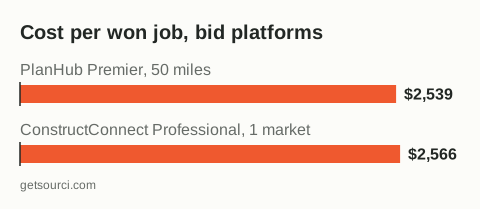
The subscription is about 5% of the cost per won job in both columns. Raise the win rate to 25% and estimating per won job drops from $2,400 to $1,440. Bidding fewer, better-fit projects saves more than switching platforms.
How does that compare with other ways to win construction work?
| Source | How the cost works | Example cost per won job |
|---|---|---|
| Bid platform, as above | Subscription plus estimating time | $2,539 at a 15% win rate |
| BuildZoom | 2.5% of the job value, paid when hired | $5,000 on a $200,000 job (example job value) |
| Sourci outbound Foundation | $2,950 a month | Sourci's outbound page shows an example path at round rates: 500 researched contacts, 10 conversations, 3 estimates, 1 won job. That is $2,950 plus 3 estimates at $360, or $4,030 |
| Referral from a past client | Your time | Close to zero in cash |
On a $200,000 commercial job at a 10% gross margin (example inputs), gross profit is $20,000. Every source above pays for itself on one win. The difference is what kind of win: a bid won on price, or a buyer who calls you first next time.
GENERATE CONSTRUCTION
How do you generate construction leads you own?
You generate construction leads you own by being findable and by contacting buyers before they put work out to bid. Owned leads come to you alone, so there is no bid list to beat on the first conversation.
- Pick two building types or buyer groups. Medical office, multifamily, industrial, retail, restaurants or schools. One page, one email and one reference list per group works better than one message for all.
- Build a project page for every job worth showing. Building type, square footage, schedule, whether the site was occupied, the owner's goal and photos. A property manager checks your site before replying. Our general contractor website design guide lists the pages that do this work.
- Keep a prequalification package ready. Owners and GCs ask for insurance, bonding capacity, safety records, licenses and references before they invite a bid. The AIA's A305 Contractor's Qualification Statement is one standard format, with exhibits for general information, financial and performance information, project-specific information and past project experience.
- Set up your Google Business Profile and local pages. Google says local results are based mainly on relevance, distance and popularity, and that there is no way to request or pay for a better local ranking.
- Answer the questions buyers ask. Pages on cost ranges, schedules, permits and occupied-site work give search engines and AI assistants something to cite. Google says the same SEO practices apply to its AI features, with no additional technical requirements.
- Contact owners and property managers directly. Use permit data and project-data services to find who is building or renovating, then reach the owner, asset manager or facilities lead before the job goes out to bid.
- Ask every finished-job owner for a reference and an introduction. One named reference in the same building type is worth more than a page of claims.
Our construction company marketing guide covers positioning, proof and a 90-day plan in more detail, and contractor lead generation explains how owned leads differ from bought ones.
CONSTRUCTION LEADS
How do construction leads for general contractors differ from subcontractor leads?
General contractors win work from owners, developers and their representatives. Subcontractors win most of their work from general contractors. That changes where each should look.
| General contractors | Subcontractors | |
|---|---|---|
| Who awards the work | Owners, developers, property managers, public agencies | General contractors and construction managers |
| Main lead sources | Dodge, ConstructConnect, public notices, owner relationships, referrals from architects | GC invitations through BuildingConnected, PlanHub and The Blue Book; GC bid lists |
| What gets you invited | Prequalification, similar projects, bonding capacity, references from owners | Being on the GC's list, a current qualification file, past performance with that GC |
| Best owned channel | Outreach to owners and property managers; project pages by building type | Relationships with GC estimators; a profile that GC search tools can find |
For subcontractors, the GC is the client lead. The Blue Book lists 150,000+ general contractors in its network and that it lists 450,000+ bid-stage projects a year. BuildingConnected says its network has over 1.5 million construction professionals. The practical move is the same on each: complete the profile, keep qualification documents current, and contact the estimators at the GCs you want to work for. Our guide to commercial painting bid opportunities shows how a trade contractor gets onto those lists.
For general contractors, construction project leads from data services matter most on public and large private work. Smaller commercial owners often never post a bid publicly. They call contractors they know. That is where outreach and search presence pay off. Our general contractor marketing guide covers the channels by job type, from remodels to commercial and design-build work.
COMMERCIAL CONSTRUCTION
Where do commercial construction leads come from, and who should you contact?
Commercial construction leads come from owners and the people who manage buildings for them. Reach the person who controls the budget or the vendor list, not only the person who answers the phone.
| Contact | What they control | When they buy | What to send |
|---|---|---|---|
| Property manager | Repairs, tenant improvements, vendor lists for managed buildings | Tenant turnover, repairs, capital plans | Similar projects in their building type, insurance, references |
| Facilities director or manager | Maintenance, renovations and capital projects for an owner-occupied portfolio | Budget cycles, shutdown windows, failures | Schedules that work around operations, safety record |
| Asset manager | Value-add plans and major capital spending for an investment owner | Acquisition, repositioning, lease-up | Cost and schedule on comparable projects |
| Owner or developer | The whole project | Before design, at site selection | Delivery methods you offer, past projects of that type |
| Architect | Who gets recommended to the owner | During design | Project pages, preconstruction capability |
| General contractor estimator (for subs) | Which subcontractors are invited | Weeks before bid day | Qualification file, unit pricing, past GC references |
There are a lot of these buyers. The Bureau of Labor Statistics counts 460,400 jobs for property, real estate and community association managers in 2025, and lists arranging for repairs among their duties. Most of them never post a bid on a public board.
Commercial outreach is email-led for most contractors. In the US, the FTC says the CAN-SPAM Act covers business-to-business email: each message needs accurate sender details, a valid postal address and a clear opt-out, and opt-outs must be honored within 10 business days. Our commercial roofing page shows how this works for one trade, and outbound lead generation explains how Sourci runs it. To compare firms that run this outreach for you, see commercial contractor lead generation companies.
QUALIFY CONSTRUCTION
How should you qualify a construction lead before you bid?
Qualify a lead before you spend estimating hours on it. A short check saves more money than any subscription discount.
- Fit. Is it a building type and size you have built? Can you show a similar project?
- Bid list. How many bidders are invited? On a public bid board, assume many.
- Decision. Is it low bid, best value or negotiated? Who decides?
- Timing. When is the bid due, and when does work start?
- Money. Is the project funded, and does it need a bond you can provide?
- Relationship. Do you know the owner, architect or GC? If not, can you meet them before bid day?
Track every bid in a sheet with source, hours spent, result and margin. After three months you will know which source and which building type produce your won jobs, and you can drop the rest.
SOURCI FITS
Where Sourci fits
Sourci is an Austin, Texas lead generation agency for painting, flooring and coatings, roofing and general contractors. You do not pay per lead, and no lead is shared with other contractors.
Outbound lead generation (researched email outreach to property managers, facilities teams and owners):
- Foundation: $2,950 a month. One buyer segment in one agreed service area, up to 500 new researched contacts a month, one approved sequence with follow-ups, interested replies qualified and handed over with context, and a monthly report.
- Growth: $4,450 a month. Up to two campaigns, two buyer segments and two service areas, and up to 1,000 new researched contacts a month.
- Calling, LinkedIn management and ads are not included. Your team handles site visits, estimates and closing.
Inbound lead generation (website, SEO and AI-search visibility):
- Foundation: $1,950 a month plus $1,000 onboarding. 4 page deliverables a month, up to 2 technical or conversion fixes, and 24 buyer questions checked monthly in ChatGPT, Google AI and Perplexity.
- Growth: $3,450 a month plus $1,500 onboarding. 8 page deliverables a month, up to two service areas and 48 buyer questions.
All fixed plans are month-to-month with 30 days' notice. Get a free AI-search check to see whether ChatGPT, Google AI and Perplexity name your company for the projects you want.
SOURCES
Where these facts come from.
- SAM.gov, Contract Opportunities
- U.S. Small Business Administration, "Prime and subcontracting" (SubNet and subcontracting plans)
- City of Austin, Issued Construction Permits (Data.gov listing)
- Shovels, pricing
- Construction Monitor
- BuildingConnected Help Center, "BuildingConnected Glossary of Terms"
- Autodesk, BuildingConnected
- PlanHub, pricing for subcontractors
- The Blue Book Network
- ConstructConnect, pricing
- Dodge Construction Network, "What Is Dodge Construction Network?"
- WebFX, "Is BuildZoom Worth It for Contractors?"
- AIA Contract Documents, "Instructions: A305-2020, Contractor's Qualification Statement"
- Google Business Profile Help, "Tips to improve your local ranking on Google"
- Google Search Central, "AI features and your website"
- U.S. Bureau of Labor Statistics, Occupational Outlook Handbook, Property, Real Estate, and Community Association Managers
- Federal Trade Commission, "CAN-SPAM Act: A Compliance Guide for Business"
- Sourci outbound and inbound plans: getsourci.com/outbound-lead-generation, getsourci.com/inbound-lead-generation
Checked November 2026.
QUESTIONS
Frequently asked questions
Where can I find free construction leads?
Free construction leads come from SAM.gov for federal contract notices, SBA SubNet for federal subcontracts, city permit data such as Austin's Issued Construction Permits dataset, and free subcontractor tools such as BuildingConnected's Bid Board and PlanHub's free profile. Past clients and GCs you have bid with are free too, and often the best source.
What are construction project leads?
Construction project leads are specific jobs heading to bid, with plans, specifications and a bid date. They come from services such as Dodge, ConstructConnect, PlanHub and The Blue Book, and from public notices. Every subscriber in the same market can see the same project, so most are won on price or on a short-list review.
How do you generate construction leads?
Pick two building types, publish a project page for each job you have finished, keep a prequalification package ready, set up your Google Business Profile, and contact owners and property managers before they go to bid. Permit data and project-data services tell you who is building; outreach and referrals turn that into a conversation.
How do general contractors get construction leads?
General contractors get construction leads from project-data services such as Dodge and ConstructConnect, from public notices on SAM.gov and state and city sites, from architects and repeat owners, and from outreach to property managers and facilities teams. Prequalification, similar projects and owner references decide who gets invited to bid.
Are paid construction lead services worth it?
They can be, if you track cost per won job. At example inputs of 96 bids a year, a 15% win rate and $360 of estimating per bid, a $1,999 PlanHub subscription works out to about $2,539 per won job, and almost all of that is estimating time. Bidding fewer, better-fit projects lowers cost more than switching services.
How do I find commercial construction leads?
Start with the people who control building budgets: property managers, facilities directors, asset managers and owners. Use permit data and project-data services to see who is renovating or building, then contact them with a similar project, your insurance and a reference. The BLS counts 460,400 property, real estate and community association manager jobs in 2025.
What is construction lead generation?
Construction lead generation is any system that brings a contractor new projects or new buyers: bid platforms, permit data, referrals, a website that ranks in search, and direct outreach to owners. Some sources sell the same project to every subscriber. Others, such as your own site and outreach, produce leads no competitor receives.
What is the difference between construction work leads and construction jobs?
A construction work lead is a chance to price a job: a bid invitation, a permit or an inquiry. A job is a lead you won. Most lead services charge for the chance, so track bids, win rate and estimating hours to know what a won job costs you from each source.
FREE CHECK
Which construction companies get recommended
in your city?
When a customer asks ChatGPT or Google AI who to hire, it names a few construction companies. Tell us your trade and city. We send you which construction companies get named, and whether you are one of them.
What you get
- We ask ChatGPT, Google AI and Perplexity the buyer questions from our 24-question method, set to your trade and city.
- We record which companies each assistant recommends or cites, and whether yours appears.
- We reply with what we found and the first gaps worth fixing.
How the 24-question method works
Result: A Dallas commercial painter grew revenue 234% and website visitors 657% in six months of SEO and AI-search work with Sourci. The owner asked us to keep the company name private. Read the Dallas case study