GC WEBSITES
General Contractor Website Design: Pages, Real Examples, Costs and a Checklist
Good general contractor website design gives each buyer a path: owners see projects sorted by building type, a process and a contact route; trade partners find bid and prequalification information. The core pages are services, a project gallery, sector pages, a prequalification page, about and contact. Published build prices run from $15 a month DIY to $24,000 custom.
Most general contractor websites are built to look good in a portfolio. The buyer judging them is a property manager, a facilities director, a developer or a homeowner planning a large remodel, and each one is checking whether you have built something like their project. This guide covers the pages a GC site needs, how commercial and residential sites differ, six real sites and what each does well, what a site costs, what gets it found in search and AI answers, and a checklist.
We reply within 2 business hours. Plans are month-to-month; cancel with 30 days’ notice.
PAGES GENERAL
What pages does a general contractor website need?
A general contractor website needs one page for each decision a buyer makes. The table lists the core pages, what each does and what it should contain.
| Page | What it does | What to include | Common miss |
|---|---|---|---|
| Homepage | Answers "do they build what I need, where I need it?" | Building types or project types, cities served, delivery methods, two or three featured projects, one contact route | A slogan with no building type or location |
| Services or delivery methods | Explains how you work with owners | General contracting, construction management, design-build, preconstruction; when each fits | One sentence per service, no detail |
| Sector or project-type pages | Ranks for and proves each building type | Project count, size range, featured projects, what is hard about that building type | All work on one "Projects" page |
| Project gallery and project pages | Proves the work | One page per project: building type, size, location, scope, schedule, delivery method, photos | Uncaptioned photo grids |
| Prequalification or "work with us" page | Answers owners and trade partners checking you | Insurance, bonding, licenses, safety program summary; bid and prequalification steps for subcontractors | Missing, or hidden in the footer |
| Safety page | Proves you manage risk | Safety program, training, how safety is tracked | Generic "safety first" line |
| About and team | Shows who runs the job | Leaders and project managers, years in business, offices | Stock photos |
| Process | Shows what happens after first contact | Preconstruction, estimate, permits, build, closeout, with typical timing | Missing |
| Contact | Gets the right inquiry to the right person | Separate routes for owners, trade partners and job seekers; offices; a short form | One form for everyone |
A residential GC also needs cost-range pages per project type and a reviews section. A commercial GC also needs the trade-partner path. Our contractor websites guide covers the general anatomy for every trade; this page goes deeper on what general contractors need.
COMMERCIAL GENERAL
How is a commercial general contractor website different from a residential one?
Commercial and residential GC sites serve different buyers with different proof. Build for the buyer you want more of.
| Commercial GC site | Residential GC and remodeler site | |
|---|---|---|
| Main visitor | Owner, developer, property manager, facilities director, architect, subcontractor | Homeowner planning a remodel, addition or custom home |
| Organizing idea | Sectors and building types | Project types and rooms |
| Proof that matters | Similar projects by building type, safety, bonding, delivery methods, team | Finished homes nearby, reviews, process, warranty, design help |
| Key page most sites lack | Prequalification and trade-partner page | Cost ranges and FAQ |
| Main call to action | Contact a named office or request qualifications | Book a consultation or start a project |
| Second audience | Subcontractors looking for bids | Past clients, for warranty and repeat work |
A firm that does both should split the paths in the main menu. A facilities director will leave a site that opens on kitchen photos.
GENERAL CONTRACTOR
Which general contractor websites are good examples?
These six sites were opened and checked on . Four are commercial builders and two are residential design-build remodelers. Descriptions are based on each site as checked.
| Site | Type and region | What it does well |
|---|---|---|
| Rogers-O'Brien Construction | Commercial builder, Texas | The homepage states 850+ employees, five regional offices across Texas, 57 years in business and its ENR Top 400 rank (74). Projects are sorted into categories such as mission critical, healthcare, higher education, office, retail and multifamily, each with its own page. A "qualification" link sends trade partners to an outside prequalification platform. |
| Linbeck Group | Commercial builder, Texas | One sentence names its delivery methods: construction management, design/build and integrated project delivery. The homepage shows year established (1938), 5M+ square feet built in the past five years and 25 AGC Build America Awards. Featured projects are grouped by sector with city, and a Solutions section covers safety, technology and Lean. A Trade Partners page sits in the main menu. |
| DPR Construction | Commercial builder, national | The headline says what it is: a self-performing general contractor focused on complex and technical projects. Separate pages cover sectors (healthcare, higher education, mission critical, office and others) and expertise (safety, preconstruction, self-perform work). Its subcontractor prequalification page lists every document required, including a bonding letter dated within 30 days, and says the form takes 20 to 30 minutes. |
| Barton Malow | Commercial builder, national | The homepage leads with 102 years in operation, 3,000 team members and 156 million hours worked in five years, linked to its safety commitment page. It has a markets menu and a contact page for each office. Its subcontractors and vendors page says all bidding and prequalification run through BuildingConnected, links a virtual plan room and lists the prequalification documents. |
| Sun Design | Residential design-build remodeler, Northern Virginia, DC and Maryland | The headline names the region. The portfolio is split by project type: whole house, additions, kitchens, primary suites, bathrooms, basements and outdoor spaces. A "tour a home like yours" section groups projects by family stage. Separate pages cover the process and the warranty, and an FAQ page answers the 15 most-asked questions, including cost drivers and timelines. |
| Case Architects & Remodelers | Residential remodeler, DC, Virginia and Maryland | The process has its own pages for design, refine, build and warranty. The portfolio is split into additions, kitchens, baths, whole house and other types. The homepage describes four neighborhood design studios and links a locations page, and an article covers remodeling costs and financing. |
What the four commercial sites share: work sorted by sector, a dedicated path for trade partners, and safety shown as a page rather than a slogan. What the two residential sites share: portfolio by project type, the process explained step by step, and answers to cost and timing questions before the first call. None of them relies on a single "Projects" grid.
GENERAL CONTRACTOR
How should a general contractor organize the project gallery?
Organize the gallery the way buyers search: by building type or project type first, then by city. A single grid of photos makes a buyer do the sorting.
- Top level: sectors or project types. Commercial sites use building types, as Rogers-O'Brien and Linbeck do. Residential sites use project types, as Sun Design and Case do.
- Second level: one page per project. Each page has a short summary first: building type, size, city, schedule and delivery method. Photos and the full story follow.
- Filters only when you have volume. Filters by sector, city and delivery method help once a firm has dozens of projects. With ten, clear category pages work better.
- Link both ways. Each sector page lists its projects, and each project page links back to its sector and to the matching service page.
- Name the hard part. "Occupied hospital floor, night work" or "historic facade kept in place" tells a buyer more than "on time and on budget."
A project page written this way does three jobs at once: it proves the work to a buyer, it ranks for that building type and city, and it gives AI assistants a specific fact to cite.
GENERAL CONTRACTOR
How much does general contractor website design cost?
Published figures depend on who builds the site. These were checked .
| Build type | Published figure | Source |
|---|---|---|
| DIY on Wix or Squarespace | $15 to $30 a month plus any template fees | InvoiceFly |
| Freelance web designer | $1,000 to $5,000 | InvoiceFly |
| Full-service agency | $3,000 to $15,000 or more when SEO setup and ongoing management are included | InvoiceFly |
| "Professional contractor website" | $2,000 to $10,000 typical | Freshy Sites |
| Hook Agency standard website | $1,000 a month over 12 months ($12,000 total), live in about 45 days, only with a recurring service | Hook Agency |
| Hook Agency custom website | $2,000 a month over 12 months ($24,000 total), only with a recurring service | Hook Agency |
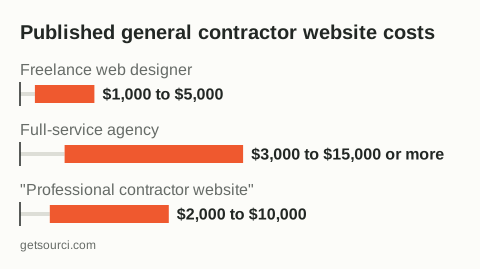
What moves a GC site toward the top of the range: the number of sector and project pages, custom photography and video, a project database with filters, and separate paths for owners and trade partners. What does not need to cost much: the prequalification page, the safety page and the FAQ. Those are writing, not design.
Plan for photography. A GC site lives on project photos, and a builder who photographs every phase of every job (demo, structure, MEP, finish) has the raw material for project pages without hiring a photographer for each one.
GETS GENERAL
What gets a general contractor website found in search and AI answers?
Search engines and AI assistants send visitors to pages that match the search and answer it directly. For a GC site, that means one page per building type and city, plain answers, and clean technical basics.
- One page per building type and per main city. "Medical office construction Dallas" and "restaurant build-out Fort Worth" need separate pages with separate projects.
- Project pages with facts. Square footage, schedule, delivery method and city give an assistant something specific to quote.
- Plain answers to buyer questions. Cost ranges, schedules, permits and occupied-site work, written as questions with direct answers.
- Structured data that matches the page. Schema.org has a GeneralContractor type under LocalBusiness and HomeAndConstructionBusiness. Google's guidance for AI features says to make sure structured data matches the visible text.
- A matching Google Business Profile. Google says local results are based mainly on relevance, distance and popularity, and that businesses with complete and accurate information are more likely to show up in local results.
- Speed on a phone. Google's Core Web Vitals targets are a Largest Contentful Paint within 2.5 seconds, Interaction to Next Paint of 200 milliseconds or less, and Cumulative Layout Shift of 0.1 or less, measured at the 75th percentile of page loads.
- Crawlable and indexed. Google says a page must be indexed and eligible to show with a snippet to appear as a supporting link in AI Overviews or AI Mode, and that there are no additional technical requirements.
AI answers lean on contractor sites. In Sourci's November 2026 study of ChatGPT and Gemini answers for commercial painting, commercial roofing and epoxy flooring across 50 US metros, ChatGPT cited the recommended contractor's own website in 911 of 1,021 recommendations. General construction was not part of that study, but a GC with a page for each building type gives an assistant the same kind of material. Read the AI contractor recommendations study.
GENERAL CONTRACTOR
What should a general contractor website checklist cover?
Run this on your homepage, one sector page and one project page.
- Building types or project types and cities in the homepage headline or first lines
- Delivery methods named (GC, CM, design-build, preconstruction)
- Separate menu paths for owners and for trade partners
- One page per sector or building type, each with projects
- One page per finished project worth showing
- Every project page states building type, size, city, scope, schedule and delivery method
- Photos captioned with project name and phase
- Prequalification summary: insurance, bonding, licenses, safety program
- Subcontractor bid and prequalification steps, or a link to the platform you use
- Safety program on its own page
- Leaders and project managers shown with roles
- Process from first meeting to closeout, with typical timing
- FAQ with cost, schedule and permit questions
- Office addresses and a contact route for each audience
- Contact form with 5 or fewer fields, project type first
- Phone number coded as a tap-to-call link on mobile
- GeneralContractor or LocalBusiness structured data that matches the page
- Title and meta description written for every page
- Site verified in Google Search Console with a sitemap submitted
- Largest Contentful Paint within 2.5 seconds on mobile
- Residential: reviews with a total count, and cost ranges per project type
GENERAL CONTRACTOR
What should a general contractor do after the site launches?
Treat the site as a record of work that grows with every closeout.
- Add a project page within a month of each closeout, while photos and details are fresh.
- Send the prequalification page link with every bid and every outreach email.
- Link the site from your Google Business Profile and every directory and platform profile you keep, such as BuildingConnected or The Blue Book.
- Track calls and form submissions by page, so you know which sector pages produce inquiries.
- Check every quarter whether ChatGPT, Google AI and Perplexity name your firm for your building types and cities.
Our general contractor marketing guide covers where the visitors for these pages come from, and our construction company marketing guide covers positioning, proof and outreach for firms that sell to business buyers. Trade-specific site guides: roofing website design and painting contractor websites.
SOURCI FITS
Where Sourci fits
Sourci is an Austin, Texas lead generation agency for painting, flooring and coatings, roofing and general contractors. Its inbound lead generation plans improve the website you already have: new and improved pages, technical and conversion fixes, SEO and AI-search visibility.
- Foundation: $1,950 a month plus $1,000 onboarding. One website and one primary service area, 4 page deliverables a month (up to 1 new page), up to 2 scoped technical or conversion fixes, 24 buyer questions checked monthly in ChatGPT, Google AI and Perplexity, and a monthly report.
- Growth: $3,450 a month plus $1,500 onboarding. Up to two service areas, 8 page deliverables a month (up to 2 new pages), up to 4 fixes and 48 buyer questions.
- A page deliverable includes copy, metadata, structured data and internal links. Technical fixes are scoped changes to the existing site, not redesigns. Month-to-month with 30 days' notice. You keep ownership of your website, accounts and content.
Commercial GCs who want to reach property managers and owners directly can add outbound lead generation from $2,950 a month. Get a free AI-search check to see whether ChatGPT, Google AI and Perplexity name your firm for the projects you want.
SOURCES
Where these facts come from.
- Rogers-O'Brien Construction
- Linbeck Group
- DPR Construction
- DPR Construction, "Subcontractor Prequalification"
- Barton Malow
- Barton Malow, "Subcontractors + Vendors"
- Sun Design
- Sun Design, "Design-Build Remodeling FAQs"
- Case Architects & Remodelers
- InvoiceFly, "Contractor Websites: How to Build a Site That Brings You Jobs"
- Freshy Sites, "Best contractor websites"
- Hook Agency, Pricing
- Schema.org, GeneralContractor
- Google Search Central, "AI features and your website"
- Google Business Profile Help, "Tips to improve your local ranking on Google"
- web.dev, "Web Vitals"
- Sourci, AI contractor recommendations study: getsourci.com/research/ai-contractor-recommendations
- Sourci inbound and outbound plans: getsourci.com/inbound-lead-generation, getsourci.com/outbound-lead-generation
Checked November 2026.
QUESTIONS
Frequently asked questions
What should a general contractor website include?
A general contractor website should include a homepage that names building types and cities, a page per service or delivery method, a page per sector, a project page for every job worth showing, a prequalification and trade-partner page, a safety page, a team page, a process page and a contact page with routes for owners and subcontractors.
How much does general contractor website design cost?
Published figures run from $15 to $30 a month for a DIY builder, $1,000 to $5,000 for a freelancer and $3,000 to $15,000 or more for a full-service agency, per InvoiceFly. Hook Agency lists $12,000 over 12 months for a standard site and $24,000 for a custom one, both only with a recurring service.
What are the best general contractor websites?
The best general contractor websites sort work by sector or project type, give each project its own page with facts, and give trade partners a clear bid and prequalification path. Rogers-O'Brien, Linbeck, DPR and Barton Malow do this for commercial work; Sun Design and Case Architects & Remodelers do it for residential remodeling.
Should a general contractor website have a prequalification page?
Yes, if you do commercial work. Owners ask for insurance, bonding, licenses and safety records before inviting a bid, and subcontractors look for how to get on your bid list. DPR's prequalification page lists every document it needs, and Barton Malow's says all its bidding and prequalification run through BuildingConnected.
How many pages do general contractor websites need?
At minimum: a homepage, one page per service or delivery method, one page per sector or project type, a project page per featured job, plus prequalification, safety, about, process and contact. A firm with three delivery methods, three sectors and twelve featured projects needs about 24 pages to cover what buyers check.
How do general contractor websites show up in AI answers?
AI assistants cite pages that answer the question directly. Publish one page per building type and city, put facts on project pages, add an FAQ, and keep structured data matching the page. Google says pages must be indexed and eligible for a snippet to appear in AI Overviews, with no extra technical requirements.
Should commercial and residential work share one general contractor website?
They can share one domain, but not one path. Split the main menu so owners and property managers reach sector pages and qualifications, and homeowners reach project types, cost ranges and reviews. A facilities director and a homeowner check for different proof, and one mixed gallery serves neither well.
FREE CHECK
Which general contractors get recommended
in your city?
When a customer asks ChatGPT or Google AI who to hire, it names a few general contractors. Tell us your trade and city. We send you which general contractors get named, and whether you are one of them.
What you get
- We ask ChatGPT, Google AI and Perplexity the buyer questions from our 24-question method, set to your trade and city.
- We record which companies each assistant recommends or cites, and whether yours appears.
- We reply with what we found and the first gaps worth fixing.
How the 24-question method works
Result: A Dallas commercial painter grew revenue 234% and website visitors 657% in six months of SEO and AI-search work with Sourci. The owner asked us to keep the company name private. Read the Dallas case study