CONTRACTOR ADVERTISING
Contractor Advertising: How Each Channel Charges and What a Won Job Really Costs
The main paid channels for contractors are Google Search ads, Google Local Services Ads, Facebook and Instagram ads, Nextdoor, Yelp, direct mail, and yard signs or vehicle wraps. Each charges differently: per click, per lead, per day or per piece. Compare them on what a won job costs you, not what a lead costs.
A $40 lead that never books costs more than a $150 lead that turns into a $9,000 roof. Below: how each channel bills, the prices each platform publishes, which trades each one suits, the 2026 changes to Local Services Ads, what your ads are legally required to show in some states, and a worked cost per won job example you can rerun with your own numbers.
We reply within 2 business hours. Plans are month-to-month; cancel with 30 days’ notice.
AT A GLANCE
What does contractor advertising cost?
Contractor advertising is paid per click, per lead, per day or per piece, so compare channels on cost per won job. In LocaliQ’s home services benchmarks, updated July 2026, a search ad lead cost a median $90.92, and $165.67 in its general construction and contractors category. Your close rate decides what that lead is worth.
MAIN CONTRACTOR
How do the main contractor advertising channels compare?
| Channel | How you pay | Published price points (checked November 2026) | Best for | Main pitfall |
|---|---|---|---|---|
| Google Search ads | Per click. You set a max CPC and Google says you'll often pay less | Set by auction, no fixed rate | Buyers searching a specific service now (roof repair, cabinet painting) | Sending clicks to a homepage instead of a matching service page |
| Google Local Services Ads | Per valid lead: answered calls, missed calls that qualify, messages, voicemails, booking requests | Google says lead prices vary by location, job type, lead type and bidding mode; message leads are typically priced below phone leads | Residential trades with a strong review count | A missed call during business hours counts as a valid lead when the caller stays on the line more than 20 seconds |
| Facebook and Instagram (Meta) | Budget you set | No public rate card | Visual trades (painting, coatings, remodels), seasonal offers, retargeting site visitors | Form leads from people scrolling, not searching |
| Nextdoor | Daily budget, charged upfront | Recommended plans of $3, $5 or $10 a day; charged daily budget times 31 days, rebilled every 31 days | Neighborhood residential work | Reach stops at the neighborhoods you pick |
| Yelp ads | Monthly budget, cost per click | Ads "from $150/month," cancel anytime; ads plus upgrade package from $270 a month; CPC set by automated auction | Trades where buyers already compare on Yelp | Project requests can go to several businesses at once |
| Direct mail (USPS EDDM Retail) | Postage per piece plus printing | $0.26 per piece for Marketing Mail flats; 200 minimum and 5,000 maximum pieces per day per ZIP Code | Painting, roofing and coatings in neighborhoods with the right home age | Postage excludes design and printing; untracked without a unique number or URL |
| Yard signs and vehicle wraps | One-time print and install | No platform price to cite | Repeat visibility on streets where you already work | Hard to measure without a dedicated number or URL |
GOOGLE ADS
Google Ads for contractors
Google Ads for contractors usually means Search campaigns: your ad shows when a buyer types a service and a place into Google, and you pay when they click. Google says your maximum cost per click is the most you will typically be charged, and you will often be charged less.
LocaliQ’s 2025 search ad benchmarks for home services, updated July 2026, show what the market pays. The figures are medians from 3,211 US home services search campaigns that ran from to .
| LocaliQ category | Median cost per click | Median conversion rate | Median cost per lead |
|---|---|---|---|
| All home services | $7.85 | 7.33% | $90.92 |
| Construction and contractors (general) | $5.31 | 2.61% | $165.67 |
| Paint and painting | $13.74 | 10.80% | $138.38 |
| Roofing and gutters | $10.70 | 3.70% | $228.15 |
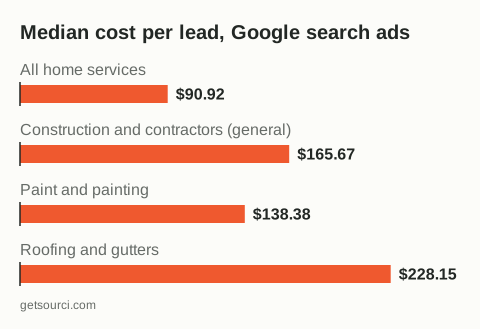
Painting clicks cost the most in that table but convert best. Roofing and general contracting clicks cost less but convert less often, so their leads cost more. The setup decides which side of those medians you land on:
- One ad group per service. Each one lands on the page for that service, not the homepage.
- Location targeting that matches your crews. Google lets you target areas or a radius around a location, so draw it around where you want to work.
- Negative keywords. Google says they let you exclude search terms from your campaigns. A contractor would exclude searches such as jobs, salary and DIY.
- A tracking number or form tag per campaign. Calls and forms then tie back to the keyword, so you can work out cost per won job with the formula below.
- A weekly look at the search terms report. It shows the searches you paid for and the negative keywords to add next.
Local Services Ads charge per lead instead of per click and are moving into Google Ads. The next section covers that change.
CHANGED LOCAL
What changed with Local Services Ads in 2026?
Google is moving Local Services Ads into Google Ads. Existing LSA campaigns are being migrated automatically to a Performance Max campaign type built for pay-per-lead goals. Per Google's Ads help center:
| What | Detail from Google's help page |
|---|---|
| Phase 1, August 2026 | Select U.S. home and storefront service advertisers, including plumbing, HVAC, electrical, appliance repair, house cleaning, lawn care, roofing, pest control and moving |
| Phase 2, late 2026 | Broader groups, including service-area businesses without storefronts and accounts with custom bidding or booking setups |
| 2027 | Non-U.S. accounts and every category not migrated in 2026 |
| What stays the same | You still pay only for valid leads such as calls and messages; ads still show on Google Search and Maps; targeting stays keywordless, based on categories and service areas |
| Notice | Account admin gets an email 14 days before the migration date, plus dashboard banners and a reminder 7 days later |
| Settings | Locations, service types, categories, budget limits, ad schedule and photos transfer; verification status and the Google Verified badge carry over |
| Bidding | Manual bidding, such as a maximum cost per lead, is no longer supported |
| Budgets | Weekly budget divided by 7 becomes a daily average; monthly spend is capped at the daily average times 30.4 |
| Reports | Past performance reports (impressions, clicks, weekly spend) do not carry over. Google says a download page is coming and to take screenshots if you need the reports now. Past leads do carry over |
If you serve customers at the job site and have no storefront, Google's timeline puts you in the late-2026 group unless your account moved in August. Save your LSA reports now, and note your current cost per lead by job type, because you lose the max cost per lead control after the move.
Google's lead credit rules matter as much as the migration. Google says invalid or low-quality leads are not charged, charged leads are reassessed over time, and credits usually post within 30 days. Google no longer credits "job type not serviced" or "geo not serviced" leads, so a stale service list or a service area drawn too wide is now money you do not get back.
CALCULATE COST
How do you calculate cost per won job?
Use one formula for every channel:
Cost per won job = total spend for the period / jobs won from that channel in the period
To estimate before you spend, walk the funnel from spend to leads to estimates to jobs won. The example is a residential painting contractor with a $5,500 average job. Every rate marked "example input" is an assumption to replace with your own numbers.
| Step | Google Search ads | Local Services Ads | Direct mail (EDDM Retail) |
|---|---|---|---|
| Monthly spend | $3,000 (example input) | $3,000 (example input) | 5,000 pieces: $1,300 postage at $0.26 + $1,000 printing at $0.20 a piece (example input) = $2,300 |
| Unit cost | $18 per click (example input) | $75 per lead (example input) | n/a |
| Leads | 167 clicks × 12% call or form rate (example input) = 20 | $3,000 / $75 = 40 | 5,000 × 0.5% response (example input) = 25 |
| Cost per lead | $150 | $75 | $92 |
| Estimates booked | 50% (example input) = 10 | 50% (example input) = 20 | 60% (example input) = 15 |
| Close rate | 35% (example input) = 3.5 jobs | 25% (example input) = 5 jobs | 30% (example input) = 4.5 jobs |
| Cost per won job | $857 | $600 | $511 |
| Revenue at $5,500 per job | $19,250 | $27,500 | $24,750 |
| Ad cost as % of revenue | 15.6% | 10.9% | 9.3% |
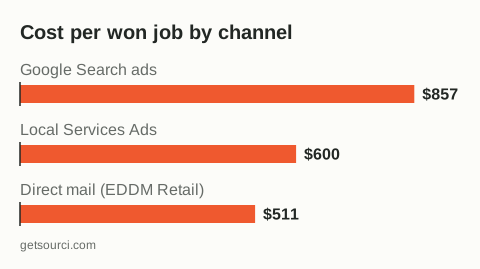
Search ads carry the highest cost per lead in this example and the best close rate, because the buyer typed the service into Google. Lift that close rate from 35% to 50% and Search drops to $600 per won job, level with LSA. The channel that looks worst on a lead report can be the one worth scaling.
How much should a contractor spend on advertising?
Two ways to set the number. Angi's contractor advertising guide passes on a Builder Magazine rule of thumb: start at 1% or more of gross annual revenue. For a painting company grossing $1.2 million (example input), that is at least $12,000 a year, or $1,000 a month.
The sharper method sets a ceiling per won job:
Maximum cost per won job = average job value × gross margin × share of gross profit you will spend to win the job
Example inputs: $5,500 job × 40% gross margin × 30% = $660. In the funnel table, Local Services Ads ($600) and direct mail ($511) clear that bar. Search ads ($857) need a better close rate or a cheaper click. Spend can rise as long as each channel stays under the ceiling.
FACEBOOK ADVERTISING
Does Facebook advertising work for contractors?
It works for trades where a photo sells the job: exterior repaints, cabinet refinishing, metallic epoxy garage floors, deck and kitchen remodels. The buyer is scrolling, not searching, so expect more leads that need a second touch than you get from Search.
What separates Facebook campaigns that book jobs from ones that burn budget:
- Real before and after photos from your own jobs. Same angle, same light, the finished job filling the frame. Stock photos read as a lead mill.
- A qualifying question on the form. Project type and ZIP code at minimum, so you can drop out-of-area requests before calling.
- A call back the same hour. Form leads cool off fast because the person was not looking for you an hour earlier.
- Retargeting your website visitors. People who read your cabinet painting page last week are warmer than a cold audience of homeowners aged 35 to 65.
- One offer per campaign. "Exterior repaint, free color consult, booking April starts" beats a list of every service you sell.
MUST CONTRACTOR
What must a contractor ad include?
Some states make the license number part of the ad. The California Contractors State License Board says licensed contractors must include their license number in all forms of advertising, including websites, business cards and vehicle lettering, with a civil penalty of $100 to $1,000 for a first offense. Arizona's Registrar of Contractors changed its rules in 2021 so vehicle, radio, internet and billboard ads can skip the number if they show a web address and the name and license number appear clearly on the site's homepage, not only in the footer; bids, contracts and estimates still need it. Check your own state board before printing wraps or yard signs.
Beyond the legal minimum, every ad should carry:
- The service and the city in the headline ("Roof replacement in Round Rock," not "Quality you can trust")
- A photo from your own job
- A tracking phone number or URL unique to that channel
- A landing page for that service, not the homepage
- Your review count or rating, where the platform allows it
MOST COMMON
What are the most common contractor advertising mistakes?
- Judging channels by cost per lead. Track leads to estimates to jobs. The funnel table above is the test.
- Sending paid clicks to the homepage. Each ad group should land on the page for that service and city.
- Missing calls on Local Services Ads. A missed call during business hours can still be a charged lead.
- No tracking number per channel. Mail, signs and wraps cannot be compared without a unique number or URL each.
- Stacking shared-lead platforms. Buying the same homeowner's request on three platforms means bidding against the same rivals three times. Our Thumbtack and Angi alternatives guide covers the options.
- Ignoring reviews. Ad clicks often end on a profile where buyers read reviews before calling, and Google states that more reviews and positive ratings can help local ranking. Ask for a review after every finished job.
- Leaving the LSA service area wider than you work. Leads outside your listed job types or area are no longer credited.
- Running ads with no organic base. When the budget stops, the calls stop.
ADVERTISING CHANNELS
Which advertising channels fit each trade?
| Trade | Channels that usually fit | Notes |
|---|---|---|
| Roofing | Google Search, Local Services Ads, direct mail to neighborhoods after a hail or wind event, yard signs on active tear-offs | Roofing is named in Google's first LSA migration phase. More in roofing contractor marketing. |
| Painting | Facebook and Instagram (before and after), Nextdoor, direct mail, Google Search for cabinet and exterior work | Exterior work is seasonal in most markets, so mail before the season opens, not in the middle of it. See painting contractor marketing. |
| Flooring and coatings | Facebook video of finished garage floors, Google Search for epoxy and polyaspartic terms | Search volume is low, so the page that converts matters more than traffic. See flooring and coatings. |
| General contracting | Google Search by remodel type, portfolio sites such as Houzz, yard signs during the build | Long sales cycles, so retargeting past site visitors earns its keep. |
| Commercial work (any trade) | Direct outreach to property managers and facilities teams | Consumer ad platforms reach homeowners, not facilities buyers. See outbound lead generation and our property manager vendor list guide. |
GENERAL CONTRACTORS
How should general contractors advertise?
General contractors should advertise by project type. Run Google Search ads for each remodel type, each landing on its own page, and Local Services Ads under the General contractor, Kitchen remodeling or Bathroom remodeling categories. Add job-site signs and neighbor mail around active builds. Commercial GCs get little from consumer ads and do better with direct outreach.
- Search ads split by project type. A kitchen ad group lands on the kitchen page, an addition ad group on the additions page. One "remodeling" ad group sending every click to the homepage wastes the most budget.
- Local Services Ads under the right category. Google lists General contractor, Kitchen remodeling and Bathroom remodeling as Local Services Ads categories. Service-area GCs without a storefront fall in Google's late-2026 migration group, after which a maximum cost per lead can no longer be set.
- Houzz for design-led remodelers. Houzz lists its advertising add-on from $499 a month, sold alongside Houzz Pro subscriptions that start at $199 a month.
- Neighbor mail around active jobs. At $0.26 a piece in EDDM Retail postage, 1,000 pieces around a job site cost $260 before printing.
- Retargeting with a long window. Remodel buyers compare several firms before they call, so keep past site visitors in an audience long enough to see a second and third ad.
- Outreach instead of ads for commercial work. Owners and facilities teams do not pick a GC from a social feed. See outbound lead generation.
Our general contractor marketing guide compares every GC channel by job type, with a 90-day plan. For remodelers, see remodeling contractor marketing; for firms that sell to owners, see construction company marketing.
ADVERTISING SEO
How do advertising and SEO work together?
Ads produce calls the week they run and stop when the spend stops. Service and city pages that rank keep producing calls after the work is paid for. A practical split: run Search or Local Services Ads for your two highest-value services while you build the pages that rank for them, then move budget as organic calls catch up. Those same pages become the landing pages your ads need. Our contractor SEO guide covers what that work costs and how long it takes.
SOURCI FITS
Where Sourci fits
Ads management is not included in Sourci's plans. Sourci builds the inbound side that ads land on and that keeps producing when ad spend pauses, plus outbound for commercial contractors. Sourci is based in Austin, Texas and works with painting, flooring and coatings, roofing, general contractors and remodelers.
Inbound (website improvements, SEO and AI-search visibility in ChatGPT, Google AI and Perplexity; residential and commercial): see inbound lead generation.
- Foundation: $1,950 a month + $1,000 onboarding. 4 page deliverables a month, 1 site, 1 service area, 24 buyer questions tracked monthly across 3 AI engines.
- Growth: $3,450 a month + $1,500 onboarding. 8 page deliverables a month, up to 2 service areas, 48 buyer questions.
Outbound (researched email outreach to property managers, facilities teams and commercial owners, with follow-up and qualified handoffs; commercial only):
- Foundation: $2,950 a month, up to 500 researched contacts a month.
- Growth: $4,450 a month, up to 1,000.
All plans are month-to-month with 30 days' notice. Sourci never sells or shares leads. A commercial painting contractor in Dallas, Texas grew revenue 234% and website visitors 657% over six months of Sourci's SEO and AI-search work (Dallas commercial painter case study).
Get a free AI-search check to see which buyer questions name your company before you raise ad spend.
SOURCES
Where these facts come from.
- Google Ads Help, "Cost-per-click (CPC): Definition"
- Google Ads Help, "Local Services Ads transition to Performance Max campaigns with pay-per-lead goals"
- Local Services Help, "Getting started with Local Services Ads" (eligible categories)
- Houzz Pro pricing
- Local Services Help, "How leads work"
- Local Services Help, "About Automated Local Services Ads lead credits"
- Google Business Profile Help, "Tips to improve your local ranking on Google"
- Nextdoor for Business, "Tips for selecting a budget for Nextdoor Ads"
- Yelp for Business, "Local Business Pricing"
- Yelp Support, "How is the cost-per-click for Yelp Ads determined?"
- Yelp Support, "How does Yelp's Cost Per Click (CPC) advertising program work?"
- Yelp for Business, "How to get job requests from customers on Yelp"
- USPS, Every Door Direct Mail
- Contractors State License Board (California), Advertising Guidelines
- Arizona Registrar of Contractors, "Changes to Arizona Law Regarding Advertising Requirements for Contractors"
- Angi, "Contractor Advertising"
- Sourci inbound and outbound plans: getsourci.com/inbound-lead-generation, getsourci.com/outbound-lead-generation
- Sourci case study, Dallas commercial painter: getsourci.com/results/dallas-commercial-painter
- LocaliQ, "2025 Search Ad Benchmarks for Home Services" (updated ) (checked )
- Google Ads Help, "Target ads to geographic locations" (checked )
- Google Ads Help, "About negative keywords" (checked )
Checked November 2026.
QUESTIONS
Frequently asked questions
What is the best way for a contractor to advertise?
The best channel is the one with the lowest cost per won job for your trade and market. For buyers searching right now, Google Search ads and Local Services Ads usually fit; for visual trades, Facebook, Instagram and Nextdoor; for neighborhoods you already work in, direct mail and signs. Give each channel its own tracking number so you can compare them.
How much should a contractor spend on advertising?
Angi's guide cites a Builder Magazine starting point of at least 1% of gross annual revenue. A tighter method works back from the job: average job value times gross margin times the share of gross profit you will spend to win it. With a $5,500 job, 40% margin and 30%, the ceiling is $660 per won job.
How do Google Local Services Ads charge contractors?
You pay per valid lead, such as an answered call, a qualifying missed call, a message or a booking request, not per click. Google says lead prices vary by location, job type, lead type and bidding mode. Invalid or low-quality leads are not charged, and charged leads later judged low quality are usually credited within 30 days.
Are Local Services Ads moving to Google Ads?
Yes. Google is migrating LSA campaigns into Google Ads as a Performance Max campaign type with pay-per-lead goals. Select U.S. categories including roofing started in August 2026, service-area businesses without storefronts follow in late 2026, and non-U.S. accounts in 2027. Past performance reports do not carry over, so save them first.
Are Facebook ads good for contractors?
They work best for trades with strong visual proof, such as painting, coatings and remodeling, and for retargeting people who visited your site. The buyer is browsing, not searching, so plan on faster call backs and more follow-up per lead than with Search ads.
How much does Nextdoor advertising cost for a contractor?
Nextdoor's budget guide lists recommended plans of $3, $5 and $10 a day. You are charged the daily budget times 31 days upfront and billed again every 31 days until you cancel. A $10 a day plan costs $310 per 31-day cycle.
How much does Yelp advertising cost?
Yelp lists ads from $150 a month with cancel-anytime terms, and an ads plus upgrade package from $270 a month. Cost per click is set by an automated auction, and Yelp bills only for the clicks received in each monthly billing period.
How much does Every Door Direct Mail cost?
USPS lists EDDM Retail postage for Marketing Mail flats at $0.26 per piece, with a minimum of 200 and a maximum of 5,000 pieces per day per ZIP Code. Design and printing are extra. A 5,000-piece drop is $1,300 in postage before printing.
FREE CHECK
Which contractors get recommended
in your city?
When a customer asks ChatGPT or Google AI who to hire, it names a few contractors. Tell us your trade and city. We send you which contractors get named, and whether you are one of them.
What you get
- We ask ChatGPT, Google AI and Perplexity the buyer questions from our 24-question method, set to your trade and city.
- We record which companies each assistant recommends or cites, and whether yours appears.
- We reply with what we found and the first gaps worth fixing.
How the 24-question method works
Result: A Dallas commercial painter grew revenue 234% and website visitors 657% in six months of SEO and AI-search work with Sourci. The owner asked us to keep the company name private. Read the Dallas case study